


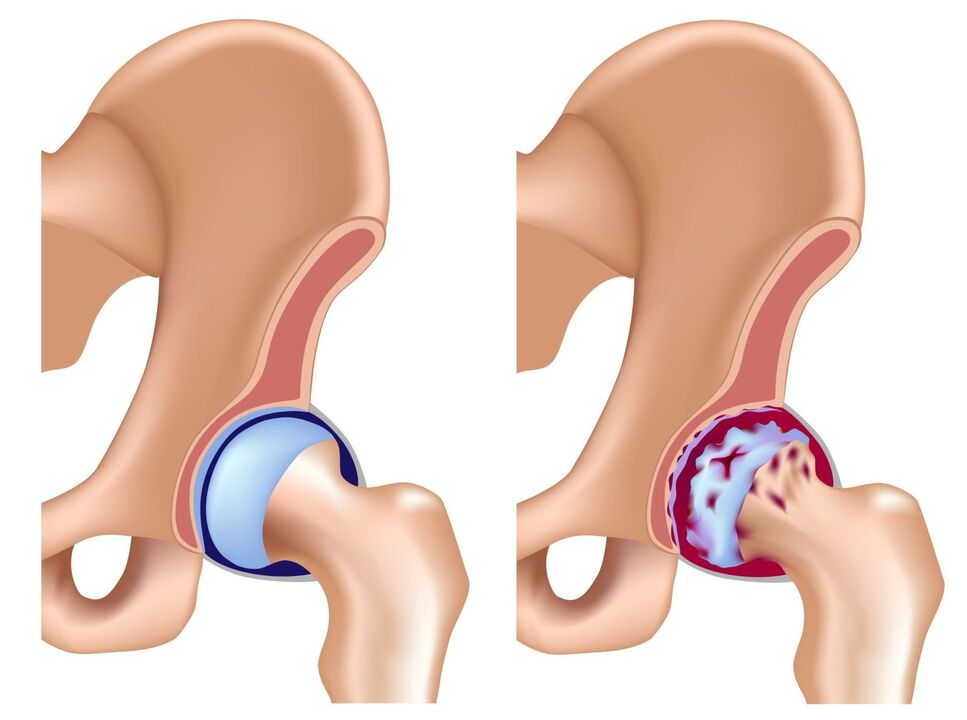
Coxarthrosis is a disease of the hip joints caused by changes in the structure of the tissues in these joints.The disease has another name – osteoarthritis of the hip joint or osteoarthritis.
Coxarthrosis is a complex degenerative disease caused by changes in the cartilage tissue of the joint.Cartilage tissue cannot be restored after the formation of the human skeleton is completed, therefore any damage to cartilage tissue affects the condition of the tissue in the future.The condition of the cartilage is also influenced by the synovial fluid, which performs the function of tissue lubrication.Due to inadequate lubrication and increased friction, the articular cartilage becomes thinner and eventually wears away completely.The lack of cartilage leads to increased load on the bone surface, friction occurs between the bones, which leads to a change in their shape and position, which leads to the appearance of pain.
Most often, people suffer from coxarthrosis in old age, since by this time the functions of the cartilage tissue have been lost.
Types of coxarthrosis
In medicine, a distinction is made between primary and secondary coxarthrosis.
In the primary case, the causes of the disease are unclear.
The development of secondary coxarthrosis is influenced by the following reasons:
- suffer various injuries and fractures;
- congenital defects in the hip joint (congenital hip dislocation);
- the presence of inflammatory processes in the hip area;
- rheumatoid arthritis (a connective tissue disease that destroys joint cartilage);
- aseptic necrosis of the femoral head (death of the femoral head).
Stages of coxarthrosis
In medical practice there are 4 stages of coxarthrosis:
Stage 1
Characterized by the appearance of periodic pain in the joint.Pain occurs when you start moving after a period of rest, but disappears upon resumption of intense activity.There is no pain when calm.The mobility of the joints is not affected.The x-ray shows slight bone growths and a slight narrowing of the joint space.
Stage 2
The appearance of pain during moderate physical activity, as well as at rest.The appearance of lameness during prolonged walking.Pain may occur in the knee or lower back.The X-ray shows: changes in the shape of the femoral head, uneven bone contour, thickening of the bone neck, significant growth of bone tissue, narrowing of the joint space by two times.
Stage 3
Regardless of physical activity, constant pain occurs, both in active and at rest states.The pain can cause insomnia.Due to limited joint mobility, a person is forced to walk with support.X-rays show a significant increase in the width of the bone neck and a decrease in its length compared to the norm, as well as deformation of the femoral head.The joint space is practically missing.The physical condition is severely limited.The patient can be recognized as disabled.
Stage 4
The patient feels unbearable pain when resting.Any movement causes extreme pain and the patient is unable to move with support (crutches, walking stick).The only method of treating coxarthrosis is surgery.
Causes of coxarthrosis
The occurrence of coxarthrosis is influenced by many reasons, but the main one is impaired blood circulation in the hip area.Due to insufficient blood circulation, metabolism in the joints slows down, leading to gradual atrophy of the leg muscles.
Other causes of coxarthrosis are:
- sedentary lifestyle;
- microtraumas that do not cause pain to the patient;
- endocrine disorders;
- age-related changes in the articular surfaces;
- increased load on the joints (most common in athletes);
- inflammatory and infectious processes in joints;
- Pathologies of the foot (flat feet) and spine (scoliosis);
- Obesity (increased load on the joint due to excess weight) and other reasons.
Taking into account the state of health of the entire organism, the exact causes of the disease for a particular patient are determined.
Symptoms of coxarthrosis
Cosarthrosis affects men and women over the age of 40.Women experience more painful symptoms.
Signs of coxarthrosis are:
- Pain in the hip joint (occurs periodically and has a painful character);
- uneven, unsteady gait (limping);
- the appearance of a crunch in the joint;
- the mobility of the injured leg is limited (in the initial stages, heaviness and stiffness in movements, fatigue and general malaise are felt);
- the appearance of atrophy of the thigh muscles (the volume and tone of the muscles change, which leads to pain in the knee).
Diagnosis of coxarthrosis
To make a diagnosis of coxarthrosis, diagnostic procedures must be carried out:
- Examination of the patient by a specialist;
- Conducting general and biochemical blood tests (allows us to detect inflammatory processes and distinguish arthritis from arthrosis);
- X-ray (to detect damage and changes in bone tissue);
- Magnetic resonance imaging of the joint (detects minor changes in cartilage tissue).
Treatment of coxarthrosis
To treat the disease, specialists use medical procedures and medications.
Treatment methods for coxarthrosis include:
- therapeutic exercises and massage;
- physiotherapy;
- ozone therapy;
- cryotherapy;
- treatment with medication;
- surgical treatment etc.
In specialized clinics, an individual treatment program for coxarthrosis is selected for each patient, taking into account his age, concomitant diseases and the stage of coxarthrosis.An individual approach helps the patient recover as quickly as possible.
Therapeutic gymnastics and massage
Gymnastics strengthens muscles and improves blood circulation.Morning exercises not only wake up the body after sleep, but also promote the promotion of synovial fluid from the lower parts of the joint.The synovial fluid lubricates the cartilage tissue with essential nutrients that increase the cartilage's resistance to stress throughout the day.
However, with coxarthrosis, physical exercises should be chosen carefully.Movements that are too sudden and forceful can cause severe pain and injure the joint.It is recommended to go to the swimming pool as swimming strengthens muscles, relieves stress on joints and does not cause injuries.
Massage for coxarthrosis is a very effective and safe method.It improves blood circulation, strengthens muscles, relieves painful cramps, swelling and muscle tension.When you massage the hip joint, lower back and back, the muscles relax, causing the synovial fluid to distribute throughout the cartilage.
Physiotherapy
Physiotherapy combines different methods:
- electrotherapy;
- UHF therapy;
- ultrasound therapy;
- laser therapy;
- paraffin therapy etc.
All of these procedures are aimed at improving blood circulation, relieving spasms and inflammation, which is due to the fact that access to the hip joint is limited.
Treatment with medication
There are many drugs that perform different functions in the treatment of coxarthrosis:
- Topical medications(Ointments, compresses, lotions).Under the influence of advertising, most patients think that treatment with various ointments and creams is the most effective way.However, this is a misunderstanding, since the healing properties of such drugs cannot reach the hip joint due to their deep location.They only temporarily help improve blood circulation and relieve cramps.The causes of coxarthrosis are not eliminated and the disease gradually develops into a more complex stage.
- Nonsteroidal anti-inflammatory drugs.They are used to eliminate inflammatory processes, relieve swelling and pain.As a result of long-term use of non-steroidal drugs, side effects occur that have a negative effect on the internal organs (gastritis).These medications do not restore the cartilage tissue necessary for normal joint function.
- Muscle relaxants(medications that relax muscles).Improve blood circulation and relieve muscle tension around the joint.The effect of the medication is temporary; joint functions are not restored.
- Hormonal steroid drugs.Intra-articular hormone injections help with concomitant diseases, for example tendonitis of the thigh bone.They have side effects and a short-term therapeutic effect.
- Vasodilators.They are used to relax the smooth muscles of blood vessels, expand the lumen between them, relieve pain in small vessels and eliminate night pain.Vasodilators also improve joint circulation and help supply the cartilage tissue with nutrients.When used correctly, vasodilator drugs have a significant therapeutic effect.However, the effectiveness of the treatment is influenced by the individual's tolerance of the medication.
- Chondroprotectors(Drugs that restore cartilage).They are the most effective modern drugs, as they affect the restoration of cartilage tissue and provide it with the necessary substances.With regular use of chondroprotectors, it is possible to stop the development of coxarthrosis.Over time, a positive result occurs and after stopping taking the drug, the process of cartilage restoration continues.
Surgical treatment of coxarthrosis
In case of significant destruction of cartilage tissue, impossibility of its restoration and immobility of the joints, surgical intervention is resorted to.In some cases, surgery is the only way to restore the ability to walk without pain.
Endoprosthetics is an operation in which the affected joint is removed and replaced with an artificial analogue, an endoprosthesis.The shape of the endoprosthesis is similar to a real joint, it fulfills all the functions of a joint and can withstand high loads when walking, running, etc.
Lifespan of the endoprosthesis
Like everything, an endoprosthesis has its own lifespan.The wear of the endoprosthesis depends on the load and mobility.Being overweight significantly increases the load and the lifespan of the prosthesis is around 10 years.With moderate stress and mobility, the endoprosthesis lasts around 15 years.There are also prosthetic models with a service life of 20-25 years, but their main disadvantage is their high cost.
After the endoprosthesis wears out, a second procedure is required to replace it.However, replacing the prosthesis is complicated by the fact that the hip bone becomes thinner over time and the problem of fixing the prosthesis arises.In order to avoid repeated endoprosthetics, it is therefore necessary to use conservative treatment methods for as long as possible.
It is worth mentioning the risks of hip replacement - the number of deaths after the operation is 1-2%.
Rehabilitation after endoprosthetics
Joint replacement surgery is quite complex and it will take time to restore lost mobility.The recovery period includes methods that strengthen the body: massage, gymnastics and breathing exercises.The volume and complexity of the loads should be increased gradually so that the body gets used to all the changes.
A healthy diet also speeds up the healing process.It is recommended to include foods rich in phosphorus and phospholipids in the diet, as their properties contribute to the restoration of cartilage tissue.
The rehabilitation phase lasts about 6 months.The patient remains under observation in the hospital for 5 to 10 days.A series of rehabilitation measures are then carried out to strengthen the hip muscles.First the patient has to walk with crutches, then with a cane and finally alone without any support.
At the end of the rehabilitation phase, the patient regains his lost ability to work and the joy of walking easily!
Prevention of coxarthrosis
To prevent coxarthrosis, it is necessary:
- maintain an active lifestyle (do morning exercises, take short walks);
- do not play professional sports;
- Maintain a balanced diet as this will help prevent weight gain, which puts additional strain on the joints.
- After 40 years, take a course of chondroprotectors every 1-2 years (if there is a family predisposition to coxarthrosis or joint injuries).